IRLDB Goes Live in Roatán: A New Model for Evidence-Driven Longevity

Mapping the Signatures of Human Longevity
A Longevity Biomarkers Summit & Competition and the Launch of the First IRLDB Cohort

A Historic First Cohort
Rejuve.AI has officially launched the International Longevity Research Database, the IRLDB, with its first 40 registrants enrolled onsite in Roatán. Roatán has recently drawn global attention as a destination for advanced biohacking and experimental therapies, with high-profile visitors such as Bryan Johnson and Khloe Kardashian. Beyond the headlines, the island is home to Prospera, a special economic zone built for regulatory innovation, and Infinita City, a crypto-native builder hub previously known as Vitalia and traces its roots to the Zuzalu pop-up movement. Over the past few years, Infinita has hosted seasonal pop-up cities attracting leading tech founders, investors, biohackers, and futurists including members of the Draper network and Brian Armstrong.
This year’s gathering, Infinite Games, is taking the form of an Olympic-style medley spanning everything from volleyball and foot races to crypto poker, electric knife fights, and frontier science challenges. Rejuve.AI is hosting one of those games: the 30-day Longevity Biomarkers Competition, launched with the Mapping the Signatures of Human Longevity conference.
Forty participants from around the world enrolled to track their biomarkers over one month using the Rejuve Longevity App, forming the first official research cohort and the first structured, participant-contributed dataset collected under the IRLDB protocol for longitudinal analysis and AI modeling.

Second Installment of JoyScore Study with Tina Woods
In parallel with the Longevity Biomarkers Competition, we collaborated on the second installment of the JoyScore Experiment, led by aging researcher Tina Woods. Tina is known for her work at the intersection of healthy longevity, systems thinking, and exposome research [1], exploring how environment, lifestyle, and lived experience interact with biological aging.
JoyScore began as a pilot at Frontier Tower and has now evolved into a structured, repeatable protocol integrated directly into the IRLDB. This second installment, the JoyScore Experiment and Longevity Rave, enrolled [Insert Final Number] participants as a subcohort within the broader Longevity Biomarkers Competition. Participants completed the full biomarker panel alongside additional layers specific to JoyScore. The Longevity Rave component brought together music, movement, and immersive experience, not as spectacle, but as an intentional intervention to explore whether joy, social connection, and altered experiential states leave measurable biological signatures.
At its core, JoyScore asks a serious scientific question: Can joy be quantified as a measurable contributor to healthspan?
Importantly, the JoyScore Experiment series does not end in Roatán. The protocol will continue in additional locations globally, using the Rejuve Longevity App as the structured data infrastructure. Each cohort feeds directly into the IRLDB, allowing cross-location comparison and longitudinal tracking. This expands the IRLDB beyond traditional biomarker collection and into whole-person longevity science, integrating biology, behavior, and lived experience within one unified data layer.

What We Measured
Participants underwent a coordinated testing protocol designed to balance scientific rigor with real-world feasibility. This full battery of tests will be repeated after one month to assess measurable change over the competition period.
This design allows us to compare biological age markers, omics data, functional performance, and subjective wellbeing within a single integrated framework. All measurements were taken at baseline and will be repeated at the end of the 30-day window, forming the basis for determining the competition outcomes. At the same time, this framework enables continued longitudinal tracking and follow-up beyond the initial competition period.

The Longevity Biomarkers Competition and Prizes
We structured four distinct prizes to reflect different dimensions of measurable longevity:
Oversubscribed Interest
Demand exceeded available capacity.
Due to unexpected logistical constraints and a late-stage partner withdrawal, we were required to limit onboarding more than originally planned. While this reduced the number of participants we could process onsite, it reinforced something important: interest in structured, participant-driven longevity research is strong.
Mapping the Signatures of Human Longevity
The 30-day Longevity Biomarkers Competition began with a two-day Summit titled Mapping the Signatures of Human Longevity, which brought together researchers, clinicians, founders, and ecosystem builders to ground the competition in scientific context.
Eric Verdin, President and CEO of the Buck Institute, spoke about biomarkers and the state of geroscience research. Tina Woods framed longevity through the lens of human flourishing and exposome science. Andrea Cipriano shared perspectives from the Biomarkers of Aging Consortium on standardization and immune aging markers in clinical trials. David Barzilai and Raghav Sehgal discussed translation into clinical settings, while Keith Comito highlighted the role of digital biomarkers and app-enabled measurement.
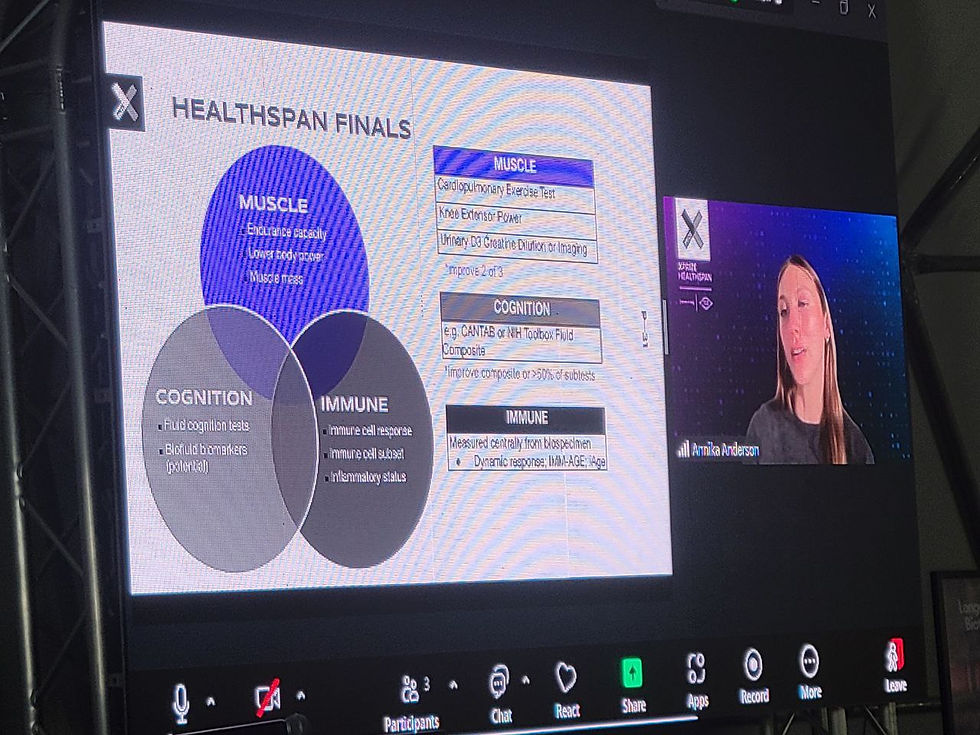
Panels tackled questions such as whether healthspan and lifespan should be treated as separate goals, how next-generation longevity therapies can scale responsibly, and what kinds of evidence we may be over- or under-valuing in the field today. Representatives from XPRIZE Healthspan and leaders within Prospera and Infinita added perspectives on incentives, governance, and experimental ecosystems.
The discussions informed how we structured the measurement framework and why we chose to ground the 30-day challenge in repeatable, publication-grade protocols rather than anecdotal experimentation.
Healthspan vs Lifespan: What the Room Actually Said
One of the most substantive discussions centered on healthspan versus lifespan, moderated by Macsue Jacques and featuring Eric Verdin, Keith Comito, Tina Woods, and myself.
Everyone agreed on the goal: extending healthy lifespan. The divergence was about plausibility and timelines. Eric took a cautious but hopeful stance. As he put it, “Some say I’m a healthspan-only guy. That’s not true.” He does not see sufficient evidence today to support 150-plus-year lifespans in the foreseeable future, but he is not opposed to radical life extension if and when the data justifies it.
Tina emphasized that healthspan is not purely biological. Joy, human connection, and the environments we design around ourselves are central to human flourishing. She spoke to the importance of building systems that support health at a societal level, while remaining thoughtful about how emerging technologies shape what it means to be human.
Keith approached the question as an inventor and technologist, highlighting how wearables and immersive tools originally developed for entertainment and gaming can be repurposed for health and longevity. He pointed to emerging non-invasive approaches, including decentralized Alzheimer’s trials using light and sound stimulation [4], as examples of how innovative platforms can translate into measurable clinical impact. He expressed optimism that meaningful age reversal may be closer than many assume, particularly if we leverage technologies already built at scale.
I supported the pursuit of radical life extension, grounded in disciplined measurement and engaged data tracking. If we can reliably move average healthy lifespan into the 90s and 100s, that alone would shift belief and momentum toward even longer horizons, echoing Tina’s emphasis on the importance of re-structuring or building new societies and designing systems that prioritize healthspan and wellbeing rather than treating them as secondary to economic growth.
The conversation was not about whether longevity should advance. It was about how far current evidence takes us today, and how boldly and responsibly we build from here.

Scaling Longevity Therapies Responsibly
A second major theme focused on scaling: How fast should we move? Through which regulatory pathways? And how do we expand access without encouraging unstructured experimentation? On the closing panel I moderated, Eric Verdin emphasized cautious innovation, underscoring the need for validated biomarkers and well-designed early trials. Niklas Anzinger introduced the concept of ‘Accredited Ingestors’, a prospective framework for informed participants to access experimental therapies within structured consent environments. Anna Vakhrusheva, CEO of UnlimitedBio noted that demand for early access already exists, with some participants even resistant to placebo arms after traveling to engage in trials. Dr. Macsue Jacques reinforced that if experimentation is happening, it must be measurable, with defined endpoints and disciplined data capture. The conversation touched on institutions such as the FDA, emerging legal frameworks including Montana Right to Try, and experimental governance models like Prospera, along with broader access to Phase I trials for informed participants. The consensus was clear: we need new frameworks and better evidence generation to move faster without compromising safety.
There are promising trials underway, including a cutting edge approach using cyclodextrins for removing atherosclerotic plaque, epigenetic reprogramming efforts, and UnlimitedBio’s combination gene therapy work in Roatán. Combination approaches may recalibrate expectations in the near term. But our current body of evidence does not yet justify the most aggressive predictions about longevity escape velocity [5].
What struck me most during the discussion was that no one framed longevity as a moral problem. No one on the panel believed that effective therapies would somehow remain ‘only for the wealthy’ if they genuinely worked. This suggests that perhaps the real constraint on ‘lifespan’ extending therapies is not ethics or public resistance. It is the depth of our evidence, the structure of our regulatory pathways, and how quickly we can responsibly translate promising science into validated interventions. There was also clear caution against random, unmeasured biohacking. Structured participation that contributes to shared data advances the field, while haphazard experimentation with unverified compounds and unregulated channels creates unnecessary risk and undermines the credibility of serious longevity research.

Panel Discussion: Anna Vakhrusheva, Eric Verdin, Macsue Jacques and Niklas Anzinger, moderated by: Jasmine Smith
App Updates and Infrastructure
The launch also coincided with meaningful updates to the Rejuve Longevity App , reinforcing that this is not just a research framework but a live, evolving platform.

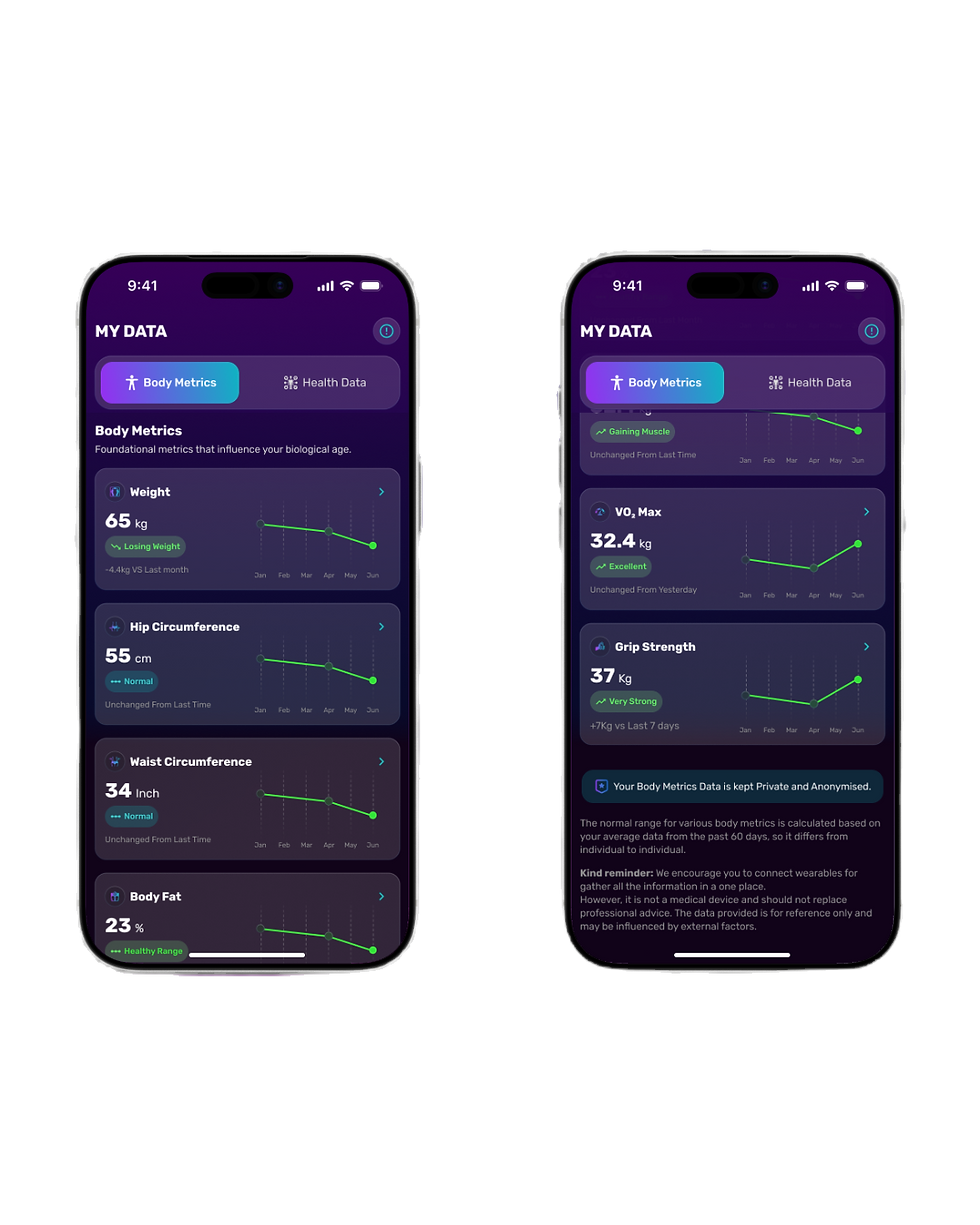
Improvements included an updated Home Screen and redesigned Daily Quests flow, with the introduction of a new Special Events category to capture major life changes such as travel, marriage or divorce, relocation, and other transitional stressors that may influence health trajectories. We also enhanced supplement logging and introduced structured medication logging to improve longitudinal accuracy and contextual interpretation of biomarker shifts.
In parallel, we expanded biomarker inputs, strengthened structured research consent pathways, and continued building toward seamless lab uploads and AI-driven rejuvenation scoring.
Participants in this cohort will be among the first to receive data NFTs, unlock premium app access, and contribute directly to structured IRLDB analysis pipelines.
This is the first operational test of the IRLDB as a living, evolving data layer.
Media Coverage
The launch and associated studies did not go unnoticed.
The San Francisco Standard covered the growing interest in “joyspan” as a longevity trend, highlighting how joy, social connection, and experiential wellbeing are increasingly being treated as measurable components of healthspan. Longevity.Technology featured the JoyScore initiative, exploring the idea that joy itself can be quantified and tracked alongside biological aging metrics. Lifespan.io reported on the official launch of the International Longevity Research Database, positioning IRLDB as a new model for structured, participant-driven longevity research.

What This Means for Rejuve + What’s Next
Launching the IRLDB at Infinite Games in Prospera was intentional. Infinita City is a place where builders, scientists, and technologists gather to test ideas in real time. That environment allowed us to move quickly from discussion to implementation.
Follow-up testing is scheduled for March to conclude the 30-day competition window and determine the winners.
Beyond the competition, this dataset will inform the next generation of product features inside the Rejuve Longevity App, including more granular micro-insights based on longitudinal biomarker and behavior patterns.
This first cohort becomes the foundation for structured n-of-1 aggregation, multi-omic integration, and repeatable trial design. It also gives us practical insight into how to run future studies, whether at pop-up cities, in-person gatherings, or fully decentralized multi-location trials.
Most importantly, it proves something simple. The IRLDB is not a concept. It is active, measurable, and already evolving.
This was the first cohort. It will not be the last.
Stay Involved
If you want early access to future study cohorts, competition results, new biomarker insights, and publication updates, subscribe to the Rejuve newsletter.
You’ll be the first to hear when new cohorts open, new data is released, and new App features go live.
Participatory longevity research has begun. Be part of it today!


