Longevity Stacks: How to Know You Have the Right Combo
Updated: Sep 22, 2025
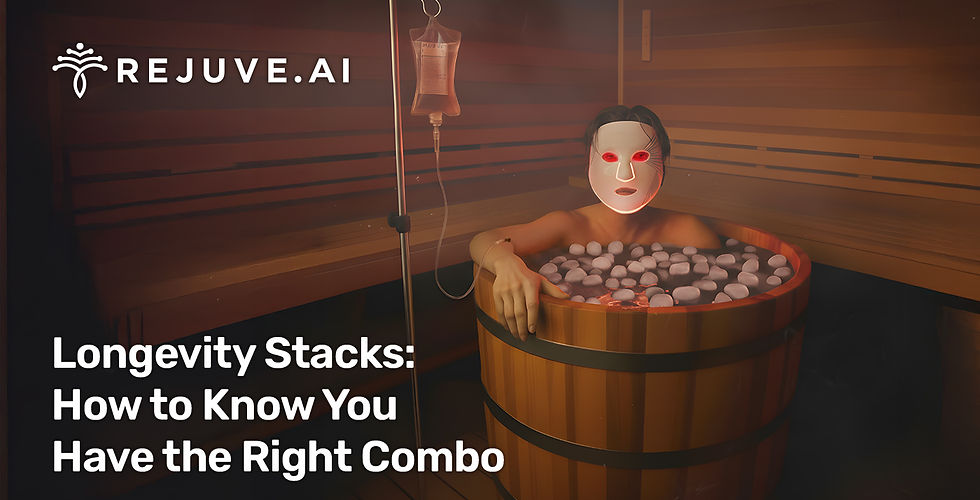
Some people pair saunas with cold plunges. Others take vitamin D alongside omega-3. Some do all of the previous. And others add layers upon layers of supplements and biohacks on top of that.
Such is the booming culture of “longevity stacks.”
The idea is simple: each of us can build a personal protocol of practices and products to optimize health. Billionaire Bryan Johnson has become the poster boy of this movement with his Don’t Die routine, a program so elaborate it would take a whole manual to list every intervention he undergoes daily.
But Johnson isn’t alone. Online platforms are springing up where enthusiasts share their stacks, debate combinations, and trade lessons from their own experiments.
Businesses have caught on too. Some supplement brands now let you select a specific domain like knee health, and then you get recommended products that should work well together for that purpose. Others take choice off the table completely, bundling dozens of ingredients into single packs supposedly designed to cover all longevity bases.
On one hand, this enthusiasm for longevity stacks among the public is encouraging. More people are paying attention to their health, and that’s just wonderful. On the other hand, a big question remains: how much evidence do we actually have that these combos work?
The answer is: hardly any.
As Professor Brian Kennedy, Director of the Centre for Healthy Longevity at the National University of Singapore, has put it:
“I can’t pick three interventions that work well together. If you’re taking 20 pills, it’s like mixing 20 colors of paint together. You’re going to get some ugly gray outcome, or at best, you’re going to get an unknown outcome that we can’t predict.”
In emphasizing the scarcity of evidence, Professor Kennedy is doing his job as a scientist to educate people about what we know and what we don't. When it comes to stacking, it leans more toward the latter. However, that won't stop people from self-experimenting.
So today, we’ll explore why research on longevity stacks is scarce, what evidence does exist for certain combinations, and how to think critically about building your own.
But first, let’s zoom out and look at how medicine has historically used combination therapies.
The Power of Combination Therapies in Medicine
The idea of combining treatments is hardly new. Ancient herbal decoctions already relied on mixtures of plants to achieve broader effects. Fast forward thousands of years, and combination therapies have transformed the course of several diseases in modern medicine.
That includes infectious diseases like tuberculosis, metabolic conditions such as obesity, and across multiple types of cancer. Patients have consistently benefited from well-designed drug combinations. Such regimens are built on decades of rigorous clinical research [1].
But why combine treatments at all? The rationales fall into a few main categories [2]:
Targeting different aspects of a disease: In heart failure, for example, one drug might reduce the heart’s workload while another lowers fluid retention. Each acts independently, but together they improve the patient’s overall condition.
Attacking the same pathway at multiple points: In oncology, chemotherapy drugs often strike cell growth at different stages of the cell cycle. By coordinating their effects, the combination intensifies the blow to cancer cells, often at lower and less toxic doses.
Enhancing the action of a primary drug: Some agents don’t fight disease directly but extend the effectiveness of others. A classic case is pairing antibiotics with inhibitors that block bacterial enzymes from destroying the antibiotic.
The results of these combinations depend on how the drugs interact [2]:
If the combined effect equals the sum of individual effects, the outcome is additive.
If the effect is less than expected, it’s subadditive or antagonistic.
If the effect exceeds the sum, the result is superadditive or synergistic.
It is precisely this synergistic potential that excites longevity stackers. The idea that two or more interventions might add up to something greater than the parts is compelling. But here we face a bit of a mystery: if combination therapies are so effective in treating diseases, why don’t we see the same robust body of research for longevity?
Why Evidence on Longevity Stacks Is Scarce
The reason is quite simple: there is little research on any intervention for longevity in the first place.
Lifespan studies are expensive and difficult to design. In humans, they would take decades to complete, which makes them almost impossible to run at scale. Even in animals, lifespan experiments demand years of monitoring and large sample sizes, which limits how many combinations can realistically be tested.
If lifespan trials are impractical, researchers need reliable biomarkers of aging that can serve as substitutes. A biomarker should predict biological age or future health outcomes with accuracy. Despite progress in epigenetic clocks, no consensus standard yet exists. This makes it hard to judge whether an intervention, let alone a combination, is truly effective.
Funding priorities also play a role. Diseases like cancer or Alzheimer’s attract more resources because they are well-defined, with clear clinical endpoints. Aging, by contrast, affects every system in the body. It’s not a single process but a network of interacting pathways that regulate metabolism, repair, inflammation, cellular communication, and more. Studying how interventions influence that network requires tools and models that are still maturing.
Recent research has begun to map aging gene regulatory networks [3]. These networks describe how genes turn each other on or off in coordinated ways, influencing the pace of aging across tissues. They reveal that small tweaks at key nodes can ripple outward, influencing multiple hallmarks of aging at once.
This systems view reinforces why combinations matter. If aging is a networked process, interventions that target different nodes in harmony could, in principle, produce stronger and safer effects than any one alone.
What Animal Models Teach Us About Longevity Stacks
When it comes to testing potential longevity stacks, animal studies are often our best guide.
Species like mice, fruit flies, and the tiny roundworm C. elegans have been unsung heroes of aging research. They live short lives, are easy to manipulate genetically, and have produced a wealth of knowledge about the biology of aging. These organisms have also given us the first hints of which combinations might extend lifespan more than any single intervention.
To make sense of the growing data, researchers created SynergyAge, a curated database of lifespan experiments involving genetic or pharmacological combinations in model organisms [4]. It catalogs how interventions interact—whether their effects are additive, antagonistic, or synergistic—and links them back to broader gene regulatory networks.
One striking entry comes from mutating the genes of C. elegans. A mutation in the rsks-1 gene extends average lifespan by about 20%, while a mutation in daf-2 increases it by 169%. Yet when both mutations are combined, lifespan soars by 454%—an unmistakable example of synergy [5].
Neither rsks-1 nor daf-2 has a direct equivalent in mammals, but they sit within conserved pathways: the mTOR pathway and the insulin/IGF-1 signaling pathway. Drugs like rapamycin and metformin modulate these same pathways in mammals [6].
The natural question is whether pairing these drugs would replicate the worm results in mammals. The National Institute on Aging’s Intervention Testing Program evaluated this in mice. However, the combination increased lifespan only in females, and according to the authors, the effect was “small” [7]. This limited effect may explain why no human trials of the combination have followed, despite both drugs being popular in longevity stacks of biohackers.
While the metformin and rapamycin mix didn’t make it to human studies, another one did. The senolytic combination of dasatinib and quercetin clears senescent cells, which accumulate with age and drive tissue dysfunction. In mice, this stack increased lifespan by 36% [8]. However, despite these preclinical gains, a human study showed no reduction in biological age for the senolytic combination [9].
These examples illustrate the challenge of translation. Biology scales in complex and often unpredictable ways. What works dramatically in short-lived organisms may produce muted results in mammals, let alone humans. Still, animal studies remain an essential compass. They reveal possibilities and remind us that synergy in biology is real, even if difficult to achieve.
This is the prospect upon which an organization like the Longevity Escape Velocity Foundation is planning a study where 20 different combinations will be tested on 2000 mice [10].
Assessing Human Longevity Combinations in Published Literature
While animal studies prove its existence, synergy has been more elusive in the limited studies on human longevity stacks. Still, it's worthwhile to parse examples of these studies and assess the evidence of whether the combined interventions that were tested are fit to include in your own stack.
Physical Activity + Diet
The study: A large observational study used health information from over 346,000 people in the UK Biobank. Researchers followed the participants for over a decade, tracking their health habits and looking at the rates of death from all causes, heart disease, and specific types of cancer. They analyzed two key factors: self-reported physical activity and a diet quality index, which gives respondents points based on how often they eat healthy foods and how little they eat unhealthy foods [11].
The findings: When the two were combined, the participants who had both the highest levels of physical activity and the healthiest diets had the lowest risk of death overall, a 22% lower risk of all-cause mortality compared to those with low levels of both.
The verdict: Unsurprisingly, pairing exercise with diet is a winning combo. This is backed by numerous other studies, including randomized controlled trials which show biological age reductions [12]. It’s interesting to note, however, that the effect of stacking these lifestyle pillars appears to be an additive not a synergistic one.
Exercise + Omega-3 + Vitamin D
The study: This three-year study followed 777 healthy people, all 70 or older. The participants were divided into groups, each receiving either a placebo, or a daily supplement of vitamin D, omega-3, or a simple at-home exercise plan, or a combination of these. The main goal was to see if any of these interventions, alone or together, could slow down biological aging using epigenetic clocks [13].
The findings: When taken alone, only the omega-3 supplement was found to slow biological aging. However, when all three—omega-3, vitamin D, and exercise—were combined, they had a small but noticeable additive effect on biological age. The combined stack slowed down biological aging by about 2.9 to 3.8 months over the three-year study period.
The verdict: This stack seems to provide additive benefits for health and longevity, particularly if you have lower levels of omega-3 and vitamin D to begin with.
Growth Hormone + DHEA + Metformin
The study: A small one-year clinical trial called TRIIM (Thymus Regeneration, Immunorestoration, and Insulin Mitigation) was conducted to see if a mix of growth hormone, DHEA, and metformin could reverse signs of aging in a group of nine healthy men, aged 51 to 65. The main goal was to see if the treatment could regenerate the thymus gland, which is crucial for immune function and tends to shrink with age. The researchers also tracked changes in the men's biological age [14].
The findings: The treatment showed successful regeneration of the thymus glands of the participants, leading to significant increases in their thymus size as measured by MRI scans. Biological ages were, on average, 1.5 years younger than chronological ages after one year of treatment.
The verdict: While this regeneration of the thymus combined with the reversal of biological age is groundbreaking, this is still a very small-scale uncontrolled study. Metformin and DHEA were mainly used to counteract growth hormone’s side effects. So, it’s not advisable to be self-experimenting with this complex longevity stack at this point before further investigations.
Cryotherapy + Infrared Sauna + Red Light Therapy + Compression + Hyperbaric Oxygen Therapy + B vitamins + Glutathione + Vitamin D + Arginine + Ornithine + Lysine + Citrulline + Methionine + Choline + Inositol
(Now that’s a stack!)
The study: Twenty-five healthy participants aged 31 to 64 years were tracked for six months while on this multi-modal intervention. This included weekly treatments of whole-body cryotherapy, infrared sauna, red light therapy, compression, and hyperbaric oxygen therapy. The intervention also included weekly intravascular injections of B vitamins and glutathione as well as intramuscular injections of vitamin D, arginine, ornithine, lysine, citrulline, methionine, choline, inositol, and vitamin B12. Details on the doses and durations of the therapies are listed in the study. Finally, participants were asked to participate in moderate—yet unmonitored—exercise. The study looked at several outcomes, including LDL, aka "bad" cholesterol, and hsCRP, a marker of inflammation. Select participants also had their body composition and heart rate variability assessed [15].
The findings: After six months of follow-up, the participants showed reduced LDL cholesterol and hsCRP, suggesting cardiovascular health benefits and decreased inflammation. Those who had their body composition measured lost weight while preserving lean mass, while those who had their HRV measured saw increases in this metric, indicating improved resilience.
The verdict: A huge grain of salt should be added to this already stacked longevity stack. The study has several limitations, including the absence of a control group and a small sample size. Not to mention, commercial interests could be in play, as the study was conducted at and funded by a wellness center that offers all of these therapies. Individually, some of the therapies may show promise. However, from this study alone, it's hard to determine if this whole longevity stack is effective or safe and which therapies were responsible for the reported results.
**Another human study on longevity combinations to keep an eye out for is the PROMETHEUS study from the National University of Singapore's Academy for Healthy Longevity. It will investigate the combined effects of exercise, diet, sleep, and personalized supplementation with molecules like NMN and Urolithin A on the biological age of 20 people aged 50 to 80 years. The team behind the study qualified for the semifinals of the XPRIZE Healthspan, earning funding to run this highly anticipated experiment [16].
Longevity Stacks Red Flags
We have just seen examples of red flags when assessing the quality of research on longevity stacks. But what about warning signs if you’re already following one yourself? A few key signals suggest your stack may not be working as intended.
The most obvious is new or worsening symptoms. If you feel more tired, experience disrupted sleep, or notice unexplained changes in mood or digestion after adding something, that’s a sign to pause and reconsider.
Blood tests can also reveal problems before they become visible. Markers of liver, kidney, or metabolic health that shift in the wrong direction may indicate that an intervention is causing more harm than good. While not everyone will be tracking labs, even routine checkups can highlight unexpected issues linked to supplements, drugs, or lifestyle interventions.
Another red flag is redundancy. Many longevity interventions act on similar pathways, so stacking them can increase risks without improving outcomes. For example, doubling up on compounds that influence insulin signaling may only magnify side effects.
Finally, consider practicality. If a stack creates financial strain, adds stress, or becomes so complex that it disrupts daily life, the costs may outweigh the potential benefits. Longevity practices should support health, not undermine it.
Spotting these signs doesn’t mean abandoning self-experimentation altogether. It means knowing when to reassess and simplify.
Conclusion: Longevity Stacks in the Real World
Having taken the whole journey of longevity stacks, let’s revisit Professor Brian Kennedy’s quote from earlier in the article. His concern about combining 20 different pills at once is completely warranted. Luckily, few people take such extremes.
Yet in a sense, all of us already engage in far more than 20 “interventions” every single day.
Your lunch guacamole salad is an intervention. So is walking to your car, taking an afternoon nap, or keeping a habit of journaling before bed. If you reflect on your day so far, you’ll spot dozens of similar actions—all of which affect your longevity in ways large or small.
The point is that every one of us is already a longevity stacker, whether we choose to call ourselves that or not. Supplements and drugs represent only a fraction of the totality of our routines.
No single body of literature can fully capture how this totality plays out, simply because the combinations are endless.
Take diet and exercise: the aforementioned research shows that together they reduce mortality risk. But the studies don’t—and can’t—capture every variant. Was it the Mediterranean diet paired with swimming that showed the strongest effect? Or paleo with resistance training? Factor in frequency, duration, and intensity, and almost no two people follow the same protocol. And that's just on exercise and diet.
That makes traditional studies too blunt a tool to capture the reality of how unique stacks truly shape one's health.
This is real life. It's infinite possibilities. You can't test that in a controlled environment like a lab. You test real life in the real world.
This is precisely why Rejuve.AI is embarking on the enormous venture of building the International Longevity Research Database—the IRLDB.
We're embracing decentralized science (DeSci) to expand aging research beyond hospitals and universities and into everyday settings.
With the Rejuve Longevity App, individuals can track everything from diet, sleep, and exercise to supplements and advanced therapies like hyperbaric oxygen therapy or red light therapy.
But the goal isn't record-keeping for its own sake. The App connects your interventions to over 370 biomarkers, offering evidence of how your personal stack—your N-of-1 experiment—orchestrates your biology.
The App is built for studying combinations. Conventional research will remain integral when trying to identify which single intervention alters a certain biomarker.
However, life comes in stacks. So if we really want to extend it and live it more healthily, we should shift some of our efforts to studying it just the way it is.
References:
[1] Ascierto, P. A., & Marincola, F. M. (2011). Combination therapy: the next opportunity and challenge of medicine. Journal of Translational Medicine, 9(1). https://doi.org/10.1186/1479-5876-9-115
[2] Toews, M. L. (2005). Pharmacologic Principles for Combination Therapy. Proceedings of the American Thoracic Society, 2(4), 282–289. https://doi.org/10.1513/pats.200504-037sr
[3] Avila, P. U., Tsimafei Padvitski, Leote, A. C., Chen, H., Saez-Rodriguez, J., Kann, M., & Beyer, A. (2024). Gene regulatory networks in disease and ageing. Nature Reviews Nephrology, 20(9), 616–633. https://doi.org/10.1038/s41581-024-00849-7
[4] Bunu, G., Toren, D., Ion, C.-F., Barardo, D., Sârghie, L., Grigore, L. G., de Magalhães, J. P., Fraifeld, V. E., & Tacutu, R. (2020). SynergyAge, a curated database for synergistic and antagonistic interactions of longevity-associated genes. Scientific Data, 7(1). https://doi.org/10.1038/s41597-020-00710-z
[5] Chen, D., Li, P.-L., Goldstein, Benjamin A., Cai, W., Thomas, E., Chen, F., Hubbard, Alan E., Melov, S., & Kapahi, P. (2013). Germline Signaling Mediates the Synergistically Prolonged Longevity Produced by Double Mutations in daf-2 and rsks-1 in C. elegans. Cell Reports, 5(6), 1600–1610. https://doi.org/10.1016/j.celrep.2013.11.018
[6] Kulkarni, A. S., Aleksic, S., Berger, D. M., Sierra, F., Kuchel, George A., & Barzilai, N. (2022). Geroscience‐guided repurposing of FDA‐approved drugs to target aging: A proposed process and prioritization. Aging Cell, 21(4). https://doi.org/10.1111/acel.13596
[7] Strong, R., Miller, R. A., Antebi, A., Astle, C. M., Bogue, M., Denzel, M. S., Fernandez, E., Flurkey, K., Hamilton, K. L., Lamming, D. W., Javors, M. A., Magalhães, J. P., Martinez, P. A., McCord, J. M., Miller, B. F., Müller, M., Nelson, J. F., Ndukum, J., Rainger, G. Ed., & Richardson, A. (2016). Longer lifespan in male mice treated with a weakly estrogenic agonist, an antioxidant, an α‐glucosidase inhibitor or a Nrf2‐inducer. Aging Cell, 15(5), 872–884. https://doi.org/10.1111/acel.12496
[8] Xu, M., Pirtskhalava, T., Farr, J. N., Weigand, B. M., Palmer, A. K., Weivoda, M. M., Inman, C. L., Ogrodnik, M. B., Hachfeld, C. M., Fraser, D. G., Onken, J. L., Johnson, K. O., Verzosa, G. C., Langhi, L. G. P., Weigl, M., Giorgadze, N., LeBrasseur, N. K., Miller, J. D., Jurk, D., & Singh, R. J. (2018). Senolytics improve physical function and increase lifespan in old age. Nature Medicine, 24(8), 1246–1256. https://doi.org/10.1038/s41591-018-0092-9
[9] Lee, E., Carreras-Gallo, N., Lopez, L., Turner, L., Lin, A., Mendez, T. L., Went, H., Tomusiak, A., Verdin, E., Corley, M., Ndhlovu, L., Smith, R., & Dwaraka, V. B. (2024). Exploring the effects of Dasatinib, Quercetin, and Fisetin on DNA methylation clocks: a longitudinal study on senolytic interventions. Aging, 16(4), 3088–3106. https://doi.org/10.18632/aging.205581
[10] LEV Foundation. (2023). Robust Mouse Rejuvenation Study 2. LEV Foundation. https://www.levf.org/projects/robust-mouse-rejuvenation-study-2
[11] Ding, D., Buskirk, J. V., Nguyen, B., Stamatakis, E., Elbarbary, M., Veronese, N., Clare, P. J., Lee, I.-M., Ekelund, U., & Fontana, L. (2022). Physical activity, diet quality and all-cause cardiovascular disease and cancer mortality: a prospective study of 346 627 UK Biobank participants. British Journal of Sports Medicine, 56(20). https://doi.org/10.1136/bjsports-2021-105195
[12] Ho, E., Qualls, C., & Villareal, D. T. (2022). Effect of Diet, Exercise, or Both on Biological Age and Healthy Aging in Older Adults with Obesity: Secondary Analysis of a Randomized Controlled Trial. The Journal of Nutrition, Health & Aging, 26(6), 552–557. https://doi.org/10.1007/s12603-022-1812-x
[13] Bischoff-Ferrari, H. A., Gängler, S., Wieczorek, M., Belsky, D. W., Ryan, J., Kressig, R. W., Stähelin, H. B., Theiler, R., Dawson-Hughes, B., René Rizzoli, Vellas, B., Rouch, L., Guyonnet, S., Egli, A., E. John Orav, Willett, W., & Horvath, S. (2025). Individual and additive effects of vitamin D, omega-3 and exercise on DNA methylation clocks of biological aging in older adults from the DO-HEALTH trial. Nature Aging, 5. https://doi.org/10.1038/s43587-024-00793-y
[14] Fahy, G. M., Brooke, R. T., Watson, J. P., Good, Z., Vasanawala, S. S., Maecker, H., Leipold, M. D., Lin, D. T. S., Kobor, M. S., & Horvath, S. (2019). Reversal of epigenetic aging and immunosenescent trends in humans. Aging Cell, 18(6). https://doi.org/10.1111/acel.13028
[15] Chun, E., Crete, A., Neal, C., Joseph, R., & Pojednic, R. (2024). The Healthspan Project: A Retrospective Pilot of Biomarkers and Biometric Outcomes after a 6-Month Multi-Modal Wellness Intervention. Healthcare, 12(6), 676–676. https://doi.org/10.3390/healthcare12060676
[16] XPRIZE Healthspan | Qualified Teams Book 2025 https://assets-us-01.kc-usercontent.com/5cb25086-82d2-4c89-94f0-8450813a0fd3/f6499aa3-29d7-403a-83b2-47422d72178d/FINAL_XPHS_QualifiedTeams.pdf


