Rejuve’s Next Evolution

From Research Network to Longevity Intelligence Layer

Dear Rejuve Community,
Rejuve.AI is entering one of the most exciting and consequential chapters in its journey so far, and I want to share what that means for the community that has supported this vision from the beginning.
Born within the SingularityNET ecosystem, where my co-founder Dr. Ben Goertzel set out to build decentralized artificial general intelligence for the benefit of humanity, Rejuve was conceived from the start on the premise that extending healthy human life is central to that mission. The goal was never health tracking alone. It was to build genuine intelligence for the longevity domain: integrating biomarkers, behavioral data, lived experience, AI reasoning, and community participation into a system that helps individuals make better decisions for their health, while contributing to a broader engine for longevity science. Within the ASI Alliance, SingularityNET serves as the research and cognition pillar, with Hyperon forming a central part of the cognitive architecture stack.
Rejuve’s role within that wider vision is now coming into sharper focus as the research, intelligence, application, and ecosystem elements begin to connect in ways that are increasingly tangible and visible. The mission remains the same, but the path to delivering it is becoming more mature and better adapted to a rapidly advancing landscape.
What we have been building over the years is now entering a more mature and connected phase, with products, research, partnerships, and ecosystem momentum reinforcing one another more clearly in ways that I believe will become increasingly visible and meaningful to the Rejuve community, including those who have supported this mission through $RJV.
Here is how that next phase is beginning to come into focus.
Exposome Research and the Next Evidence Frontier
If you missed our dedicated post on the Roatán event, it is worth revisiting, because what happened there marks a real inflection point for this project.
Earlier this year, at Infinita City's Infinite Games event in February and March, Rejuve launched its first live research cohort through the Longevity Biomarkers Competition and the JoyScore Study. Forty participants enrolled in the International Longevity Research Database, the IRLDB, using the Rejuve Longevity App to structure data for longitudinal analysis and AI modeling. The 30-day Biomarkers Competition ran as a clean observational baseline with no prescribed interventions, a deliberate methodological choice that provides a stronger foundation for the analyses to come. The event brought together leading longevity researchers and institutions, including Eric Verdin, Keith Comito, the Biomarkers of Aging Consortium, XPRIZE, and Tina Woods, reflecting the caliber of the field now taking this work seriously.
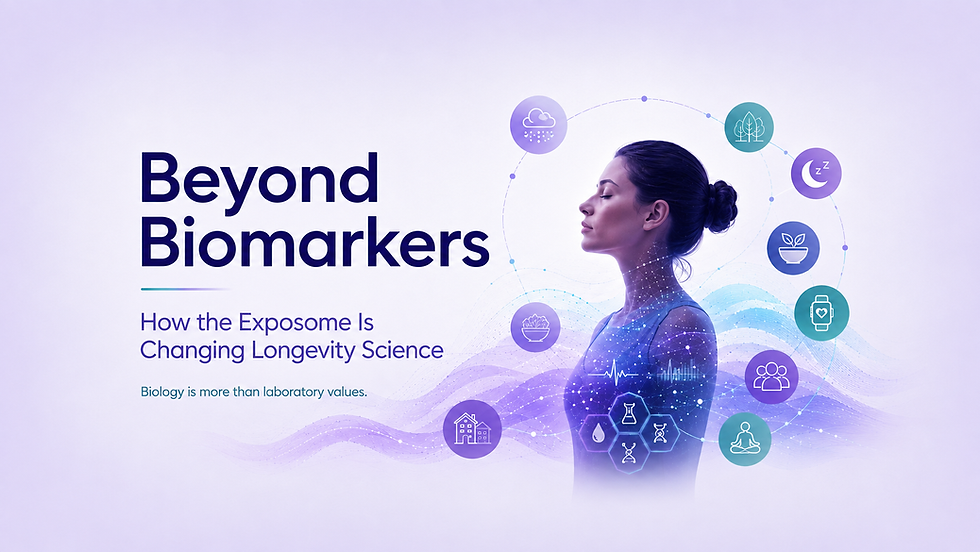
The JoyScore Study, led by Tina Woods, ran as a distinct subcohort across a series of Longevity Rave experiences. JoyScore is a multimodal research programme asking a question that most longevity science has not known how to ask: can joy, social connection, music, rhythm, and collective human experience leave measurable biological signatures relevant to healthspan? It sits within the broader Human Exposome Project as a social exposome initiative. In health and aging research, the exposome refers to the totality of environmental, social, behavioral, and sensory inputs that shape how a biological blueprint unfolds across a lifetime. Through this study, the Rejuve App captured biological and experiential data simultaneously within the same research framework. A poster informed by Phase 1 findings is being presented at the Global Exposome Summit this April, and detailed findings will be shared in a dedicated update.
This collaboration reflects what we believe is one of the most important frontiers in aging science. Two people with nearly identical genetics can age in radically different ways depending on how those factors accumulate. The importance of the exposome is becoming increasingly clear in health and aging research, and Rejuve is well positioned to play a key role in this emerging area by building infrastructure that treats biomarker data and lived experience as equally important inputs.
The Longevity App is the conduit that makes that integration possible. Rejuve's aim is to build a system where biomarker data and experiential data are structured together in ways that improve actionability, captured consistently, linked to longitudinal outcomes, and eventually translated into more precise personalized guidance. The larger direction is already clear: Rejuve is establishing itself at the intersection of exposome science and n-of-1 longevity research.
From Health App AI to Longevity Intelligence
Here is where things get genuinely exciting, and where it is worth pausing to explain what Rejuve is actually building, because “AI-powered health app” has become such a diluted phrase that it can obscure something technically and practically significant. Large language models are useful for making information accessible, conversational, and easy to explore. Longevity, however, is a domain defined by uncertainty, competing priorities, incomplete information, changing states, and highly individual circumstances. Progress depends on being able to reason across those conditions and translate that reasoning into guidance a person can actually use.
Most AI in health apps today is still a language model presented as a coach. It can summarize, suggest, and converse. What it cannot reliably do is reason through competing factors under uncertainty, account for the specific constraints of a person’s life, or construct a protocol calibrated to their history, adherence patterns, biological state, and likely points of friction. It delivers information. It does not yet deliver genuine protocol intelligence.
That distinction is important. In longevity, the challenge is not simply identifying what is healthy in theory or telling someone that sleep, exercise, or stress reduction should be priorities. It is determining what is most actionable for a specific person at a specific moment, given their biomarkers, physiology, behavioral patterns, context, preferences, budget, environment, and human tendencies. It is about deciding what to prioritize first, what can realistically be sustained, and how to turn insight into guidance that feels closer to a true longevity coach than to generic summaries and recommendations.
This is where PLN enters the picture. Probabilistic Logic Networks, or PLN, are a framework for commonsense reasoning under uncertainty, developed through the OpenCog and Hyperon lineage at the heart of SingularityNET’s AGI research. For Rejuve, the practical implication is significant: PLN makes it possible to move beyond simply retrieving or rephrasing health information and toward reasoning through what should matter most for a particular user and why. The ASI Alliance is building the broader intelligence infrastructure, and Rejuve’s role within the longevity domain is to make that kind of reasoning useful in one of the most complex and consequential areas of human life.
What makes this especially powerful is that the reasoning layer does not operate on biomarkers and health history alone. It can also draw on scientific frameworks that help organize aging at multiple levels, including biomarkers and risk markers, but also deeper conceptual models such as the Hallmarks of Aging and damage-based frameworks like SENS. In practice, that means Rejuve’s intelligence layer is being shaped to reason across multiple levels of abstraction at once, from measurable signals, to biological processes, to intervention logic, to the practical choices most likely to improve trajectory. This is how personalization becomes more biologically informed, more context-aware, and more actionable in the real world.
It is also worth acknowledging a broader shift happening in AI right now. The rise of OpenClaw has drawn attention to a new class of systems that do more than respond to prompts. They operate inside a user’s environment, use tools, take actions, and begin to function more like agentic control systems than chat interfaces. That shift matters because it signals how quickly AI is moving from information delivery toward execution.
The work being done on MeTTaClaw and HyperClaw at SingularityNET sits within that trajectory. MeTTaClaw, built by the Hyperon team, is an agentic AI system written in SingularityNET’s MeTTa language. The clearest way to explain it for anyone outside AI development: when a person uses multiple AI tools together today, the human does all the coordination. You decide which tool to use, what context to pass it, when to change direction. MeTTaClaw is designed to automate that coordination. It can remember across sessions, learn new skills, use tools, and manage its own operations across a complex task. HyperClaw, the broader cognitive orchestration architecture, extends this into a system where PLN-based reasoning can progressively replace language-model components as the underlying cognitive machinery deepens, without requiring the system to be rebuilt at each step.
These systems are still primarily in the hands of developers and technically adjacent communities and are not yet everyday tools for most people. The pace of AI development is real, however, and the gap between cutting-edge developer tooling and something running on a personal device has been shrinking faster than most anticipated. Rejuve is building with that trajectory in mind.This is what the longevity intelligence layer means in practice: a system where aging biology frameworks, biomarkers, health history, behavioral inputs, physiological signals, and experiential data can be interpreted together with enough depth to support genuinely personalized, actionable protocols at scale.
The Longevity App as the Implementation Engine
As Rejuve’s AI research matures, the Longevity App remains the implementation engine through which that intelligence becomes useful in the real world.
The platform has now crossed 5,000 accounts created, with over 600 monthly active users engaging consistently. Those are people tracking their health, building habits, and contributing longitudinal data over time. That community, and the dataset it represents, form the foundation on which the next phase of the product is being built.
The App is not simply a place to store information. It is the platform where research inputs, biomarker data, wearable integrations, survey responses, daily task completion, and behavioral signals can be brought together to form a more complete longevity strategy and living aging trajectory. It also captures mindful practices, mood, stress, and reflective behaviors: the kinds of signals that help explain why similar baseline biology can still lead to very different outcomes depending on lifestyle, emotional patterns, environment, and consistency over time.
As the App moves toward its next level, including a more advanced Pro experience, these categories become increasingly central to making insights more personalized, comprehensive, and useful. The progression from early-adopter platform to the data backbone of a registered research cohort is a meaningful one, reflecting maturity in both the product and the methodology. It has also clarified something important through real-world use: meaningful personalization requires going deeper into behavioral and experiential data, not only expanding access to biomarkers. The App is evolving into a more complete healthspan system, where research inputs, behavioral data, and more advanced personalization work together in a reinforcing loop: better adherence supports better outcomes, and better outcomes generate better data.
As new AI interaction paradigms continue to mature, including more agentic and orchestration-based systems, the way users access that intelligence may expand across web-based and other interfaces over time. What remains constant is the role of the Longevity App as the core environment where that intelligence is translated into action, refined through use, and made useful in everyday life.
Connecting the Platform to the Real-World Longevity Economy
Many of you reading this are $RJV holders, so this is the section to watch closely.
The longevity intelligence layer also needs an economic layer that works in practice. One of the deliberate shifts underway at Rejuve is the building of revenue streams that can stand independently of crypto market conditions.
The health and wellness market is vast. Its overlap with crypto is real, but still relatively narrow, concentrated largely among futurists and radical life extensionists, a community Rejuve is proud to be part of and serve. Building revenue streams that can stand independently of crypto market conditions is therefore a practical necessity. The people most motivated by health optimization exist well beyond crypto, and reaching them means building products and offerings that make sense on their own terms while strengthening the ecosystem underneath.
A broader and more resilient economic foundation also strengthens the economic layer beneath $RJV. $RJV was designed to power participation in the longevity economy by helping people access offerings across the Rejuve Network such as premium app features, partner discounts, research participation pathways, and Rejuve-native products as that layer expands.In practical terms, that means giving users a clearer way to build and sustain their own longevity protocol through Rejuve, with products, services, and partner offerings that help turn insight into action, support healthier habits, and generate richer data over time. It also creates a much clearer bridge into the wider health, wellness, and biohacking community.
Accessibility across different socioeconomic circumstances has always been part of the design. Rejuve’s goal is not to reserve longevity intelligence for a narrow audience, but to build an ecosystem where people can participate at different levels, contribute meaningful data, and access progressively more of what the longevity economy has to offer.
The community voted in favour of a buyback-and-burn mechanism as part of our updated Tokenomics Litepaper, and the result was clear. The work now is building the real pathways through which that mechanism operates in practice. As new products, curated partner offerings, and other commercial touchpoints come online, they create activity that feeds back into $RJV through transparent buyback-and-burn flows. That is how non-crypto revenue begins to reinforce the token layer.
A strong commerce layer helps close the loop between recommendation and execution. It gives users practical ways to act on what they are learning, whether through more accessible testing, curated partner offers, premium features, or tools that support deeper tracking and participation. It also allows value generated across the ecosystem to flow back into $RJV through multiple channels.
A significant product announcement is coming very soon. It marks an important milestone in this direction: the first Rejuve-native offering of its kind, designed to make the platform’s connection to everyday health optimization tangible in a form people can use directly, benefit from personally, and quite literally hold in their hands.
Looking ahead, another part of the picture is beginning to come into focus. ASI:Chain is being developed as AI-native Layer 1 infrastructure for decentralized AI and agent economies, with healthcare among the domain-specific possibilities explicitly on its roadmap. As a longevity intelligence layer being built within the SingularityNET ecosystem, Rejuve is a natural fit for the kind of infrastructure ASI:Chain is being designed to support. Over time, that opens the door for Rejuve’s longevity economy and intelligence layer to connect more deeply with an AI-native on-chain ecosystem, giving $RJV a future not only within Rejuve’s own economy, but within a wider decentralized AI stack as it matures.
Mobilizing talent across the ecosystem
The Ambassador Program has grown into something genuinely worth being proud of. The Ambassador Program is starting to show the kind of force it can become inside Rejuve, with community members bringing scientific knowledge, development skill, governance input, moderation, and creative execution directly into the work of building the ecosystem. Ambassadors are community members who voluntarily contribute their time and expertise, earning $RJV in exchange for the value they bring to the ecosystem. The quality of people who have stepped into that model has been one of the more quietly encouraging developments of the past year.
The program is now entering a new phase of structure and leadership. Rejuve has begun onboarding leads across key Ambassador tracks to help coordinate initiatives more effectively, while broader contributors continue participating more flexibly under those directions.
Right now, Rejuve is actively looking for the right person to lead the Community Developers track within the program. We are looking for someone who can bring technical fluency, coordination, and execution to a part of the ecosystem that is becoming increasingly important. This role sits directly at the intersection of product and token economy, including initiatives such as the Longevity Futures Prediction Market and dashboards that will make buyback-and-burn activity visible and verifiable. If that is your lane, the Ambassador Program is where to apply.
The Next Stage Taking Shape
What is taking shape now is a more connected Rejuve.
Our AI research is moving toward a stronger personalization engine. The Roatán cohort is expanding the evidence base for biomarker- and exposome-linked healthspan science, with much more still to share. The App is being prepared for its next stage, including the path toward Rejuve Longevity Pro, so that this intelligence can reach people in a more practical and personalized way. The reasoning architecture is continuing to evolve so that hallmarks, biomarkers, behaviors, and lived experience can be translated into guidance that is more useful in real life. Ecosystem commerce is opening new pathways for people to improve their health, contribute better data, and participate in Rejuve through multiple entry points. The token and community side of the ecosystem is evolving alongside all of this, with a clearer path between participation, value creation, and long-term alignment.
There is more to share soon across each of these areas, including deeper analysis and findings from the biomarker data coming out of the Roatán cohort and the JoyScore study, the next phase of insight personalization, the progression toward Rejuve Longevity Pro, and the upcoming product announcement.
RejuveAI is moving into a more defined phase, and the path ahead is becoming clearer. Rejuve emerged from the SingularityNET vision that beneficial AGI should serve humanity in deeply consequential ways, and few goals are more human than helping people live longer, healthier, more flourishing lives. What we are building in exposome research, personalized intelligence, and the wider ecosystem is part of that same cause. A great deal is now taking shape, and we will have much more to share with you very soon.
Thank you to everyone building with us.
— Jasmine Smith, CEO, Rejuve.AI